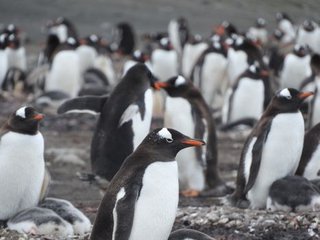
Adélie penguins exhibit colonial nesting behavior during the breeding season, traveling considerable distances from their colonies to exploit marine foraging grounds. While coloniality imposes certain costs such as heightened competition for limited resources and increased disease transmission risk, the convergent evolution of this trait across diverse animal lineages indicates substantial selective advantages. One prominent hypothesis posits that colonial breeding facilitates the acquisition of social information regarding profitable foraging locations from conspecifics, potentially influencing both individual survival and reproductive success. Despite the theoretical benefits, empirical evidence regarding the specific sources from which wild animals derive such information remains limited.