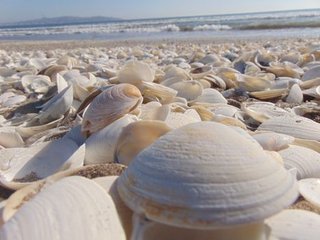
A team of biologists has discovered that the invasive Manila clam has established populations along the northwestern Atlantic coastline for the first time. This marks the final major region in the Northern Hemisphere to be colonized by this species. Researchers from the University of Massachusetts Amherst, MIT Sea Grant and the Center for Coastal Studies documented this breakthrough in the journal Biological Invasions. This represents a rare opportunity to study how an invasive species first becomes established in a new environment.
The natural range of the Manila clam extends from Sakhalin Island in Russia, through Japan and down to southern China. However, since the early 20th century, the species has spread to coastlines throughout the Northern Hemisphere through accidental and intentional introductions. The clams are highly valued as food and support a $7 billion annual industry worldwide. Unfortunately, they can outcompete native shellfish, hybridize with related species and dramatically alter local ecosystems when their populations become dense.
Dr. Aly Putnam, a postdoctoral researcher at UMass Amherst and lead author of the study, had been monitoring for Manila clams in the region. In summer 2025, while conducting a workshop on Spectacle Island in Boston Harbor, she received a text message from El Fernekees Hartshorn, a former student, showing a photo of what turned out to be a Manila clam. Along with colleague Carolina Bastidas from MIT Sea Grant, they found numerous clam shells on the island. Separately, researchers at the Center for Coastal Studies had been receiving reports of unusual clams from local fishers in Provincetown since 2023.