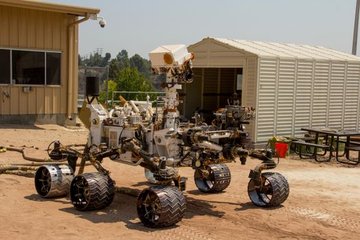
In September 2025, NASA confirmed that its Perseverance rover had identified a potential biosignature within the Bright Angel formation on Mars. A biosignature refers to any substance or structure that may have originated from biological processes. The initial discovery prompted widespread scientific interest and necessitated further investigation to validate the findings. The rover's precise sampling methodology enabled researchers to conduct detailed analyses of the Martian rock formations.
A comprehensive study published in Science Advances has now definitively confirmed the presence of organic carbon in two rock samples from the Bright Angel formation. Organic carbon, comprising the fundamental chemical building blocks of life, represents a critical indicator of potential habitability. This confirmation provides unprecedented insights into the chemical composition of Martian geology. The researchers meticulously documented the characteristics and distribution of the detected organic matter.
The paper elaborates extensively on what can be definitively established regarding the nature and origin of the detected organic compounds. While the presence of organic carbon does not constitute conclusive proof of ancient Martian life, it significantly enhances our understanding of the planet's potential to support biological processes. The findings suggest that Mars may have harbored conditions conducive to microbial existence in its distant past. Further investigation will be essential to determine whether these compounds originated from biological or abiotic geological processes.