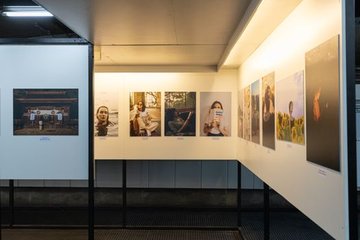
The Baltic in Gateshead is hosting an exhibition that pairs two photographers whose work could not be more different in tone, yet both capture residents of Newcastle pursuing happiness under difficult circumstances. Tish Murtha's documentary photographs from the late 1970s and early 1980s record a city undergoing radical transformation—industry in decline, unemployment soaring, working-class communities struggling to survive. Her unflinching black-and-white images possess an raw authenticity that derives from her position as an insider photographing her own neighbourhood. Kuba Ryniewicz, who relocated to Newcastle from Poland in 2004, offers a markedly different perspective: his vivid, colour-saturated work transforms the mundane—weeds erupting through concrete, buses lumbering through suburbia, pregnant bellies—into what the reviewer describes as a "magical utopia."
Close to Home presents four of Murtha's landmark series—Elswick Kids, Save Scotswood Works, Youth Unemployment and Elswick Revisited—alongside three of Ryniewicz's recent projects: Daily Weeding, Cornered Study and Good Eggs. The salon-style hang groups images of varying dimensions together on the walls, with each series featuring one enlarged print covering nearly an entire wall, creating a dynamic viewing experience. Documentary footage of Murtha discussing her practice plays alongside the Save Scotswood Works collection, offering her perspectives on documenting community struggle and her frustration with government policy failures.
The fundamental challenge facing this exhibition, as the reviewer acknowledges, is that Murtha and Ryniewicz operate in fundamentally different registers—one grappling with industrial decline, economic hardship and political protest, the other celebrating the small joys of daily life. One wall depicts residents marching through Newcastle's city centre in protest against the closure of Scotswood Works; opposite it hangs a guinea pig nestled against a man's hairy chest. The reviewer concludes that despite occasional moments of resonance—such as Ryniewicz's film asking residents what has made them happy today, which echoes the universal responses Murtha's subjects might have given—the exhibition ultimately fails to forge a coherent narrative connecting these divergent visions of home.